“The Funeral,” by Richard Matheson

Matheson must have based his funeral parlor director, Morton Silkline, on every stereotype he could find. Silkline is smooth, and he’s light on his feet; he really is like a dancer, gliding around, offering both sympathy and comfort to the recently bereaved. And all while never losing sight of the whole point of the thing for him – the money. That he does it all in a completely seamless, and genuine manner, is what makes him a perfect monster.

So it’s no surprise that word somehow gets out. To the other monsters, that is. (Because even monsters must have their own grapevine.) This is where Ludwig Asper comes in. Having been, most likely, unceremoniously dispatched by some blood-thirsty vampiric wretch hundreds of years ago, Asper missed the best part of dying – his funeral. So now he intends to make up for that by throwing himself a big bash at Clooney’s Cut-Rate Catafalque, and all his monster friends will be there. (Incidentally, I had to look up the word “catafalque” – it means “a raised structure on which the body of a deceased person lies or is carried in state; a hearse.”1)

I thought this story was a pleasant, little romp.  Silkline was perfect, and despite that little hiccup at the beginning, where he gets upset at Asper’s “joke”, by the end of the story he shows himself to be the ultimate parasite – totally adaptable to the new situation.  The best part of this story was all the other monsters who attended Asper’s “funeral.” As a few other people have already pointed out – this group acted like any other family. You had the cantankerous, but sweet, crazy cat-lady aunt; the creepy uncle (who never says anything but, “Tasty”); the dignified grand-dad, “Count”; the weird, werewolf cousin, and the assorted “others” who always seem to be there.

Predictably, this group of misfits is seldom in the same room together, and so are not very good at getting along. (Jeez, that sounds so familiar.) But, like most “normal” families, they make an attempt at being nice until the strain is too much for them, and then all hell breaks loose.

The story was a quick read, and it showed the author’s more playful side. I have to say, the creepy gnome-guy who kept murmuring, “tasty” was my favorite. I think I have sat next to that guy, or one of his relatives, on the subway a couple of times. Creepy! Jenny the witch was also good, mostly because I think I have become the “Jenny” in my family. (Eh. Someone’s got to do it.)

I also loved that Matheson did such a nice job of portraiture in this little story – I could see every character clearly, but none more so than Silkline.  It was fun to watch him morph from an ordinary, run-of-the-mill leech at the beginning of the story – plump, well-fed, doing very nicely, thank you very much – to an imperturbable and sleek bloodsucker.  As someone else so helpfully pointed out, Silkline had an actual character arc in this story.

His mother would’ve been so proud.


  1. dictionary.com

Matheson, Richard, “The Funeral”. I Am Legend. 1995. New York: Tor, 2007

I Am Legend, by Richard Matheson

I’ve always loved Richard Matheson’s work. He was writing genuinely good scary stuff back when everyone else equated “scary” with “juvenile, stupid monsters”.  This is the first time I had actually read this novella, though. I did see the movie starring Will Smith, which was excellent. But now, I’ve got Will Smith stuck in my head while I’m reading the story, and in many ways, I preferred the movie version.

Don’t get me wrong – I did appreciate that Matheson’s Robert Neville was a more nuanced guy than the average horror story protagonist, but every time Matheson mentioned the guy’s “blond hair” it threw me out of the story, because the whole time I was imagining Will Smith! Nevertheless, there was a lot here that I admired about Matheson’s take on this “the last man on Earth” story.

For one, I can totally see how, after several hair-raising months (years?) of dealing with these “things”, you would turn to drinking. A LOT of drinking, in his case.  I thought all that was both realistic and understandable. And, even though it is probably realistic, I really did not like how Neville kept obsessing over the female vampires. Has nobody told this guy about the wonders of masturbation?

Then again, this was written in the Fifties, so the answer is NO. And that’s why homeboy was half out of his mind with all those “forbidden desires.” Sheesh.

However, between the guy’s generally cranky demeanor, and all these other issues, I thought Neville was not a very sympathetic character. Interesting. Realistic. But not somebody I was rooting for.

Another thing, when I first see Robert Neville trying to figure out the nature of his vampire/zombies, I actually felt a little impatient.  Come on, man — Everybody knows what causes vampires/zombies, right?

But then I remembered. Everybody did NOT know about them back in the Fifties!

So, Matheson was kind of feeling his way around in the dark on that one. Interesting that he hit on the virus idea, though. And unlike some people, I liked the idea of the pathogen being spread across the country by dust storms. For one thing, it gave the setting more of an apocalyptic feel, plus it was a nice, fresh idea with visual appeal. I imagined these huge, brown dust storms blowing through a desolate and decayed Los Angeles. Cool.

I liked how Matheson chronicled Neville’s daily existence. It gave me lots of good ideas to use for when the zombie apocalypse really happens. I also liked how, once he sees, and then captures, the woman he then spends a lot of time stewing in paranoia and distrust. That felt realistic, too. After being alone for so long, he was bound to be suspicious of anything new that looked too good to be true.

The only thing that didn’t ring true in this story was the ending. Frankly, I did not get the reasoning behind why they felt they had to kill him. It made no sense to me. The guy was immune to the virus AND he managed to survive all this time on his own. Give the guy a medal, or at the very least, EXPERIMENT on him to find out his secrets! But, kill him? Bleh.

I also felt sorry for the way the so-called humans killed off Neville’s private pain-in-the-ass, Ben Cortman.

Anyway, I still love Matheson, and I think this story has a lot to offer us horror geeks. If for no other reason than to see the origins of so many future vampire/zombie story lines.

Matheson, Richard. I Am Legend. New York: Tor, 2007. Print.

MOVIE REVIEW: Ghostbusters, directed by Ivan Reitman

The semester is almost over, but we get to end it on a high note with the 1984 classic, Ghostbusters. Written by co-stars Dan Aykroyd and Harold Ramis it is the tale of three sleazy academic parapsychologists turned sleazy professional ghost hunters in New York City.

Peter Venkman (Bill Murray), Raymond Stantz (Dan Aykroyd) and Egon Spengler (Harold Ramis) get fired from their parapsychology research jobs at Columbia University after a ghost-hunting disaster at the New York Public Library. Since they have already developed their proton-pack weapons to fight the ghosts, along with a special containment unit to trap them, they decide to go into business for themselves as a paranormal investigations and extermination service. One thing they must never, ever do, says Egon is “cross the streams” coming from their proton packs. It would be cataclysmic.

They set up shop in a dilapidated old firehouse and go to their ever-more-frequent ghostbusting service calls in a restored hearse. They are soon hired by cellist Dana Barrett (Sigourney Weaver) who thinks her apartment is haunted by a demonic spirit called Zuul. Despite Venkman’s romantic interest in Dana, she still ends up possessed by Zuul, a.k.a The Gatekeeper. Dana’s nerdy accountant neighbor, Louis Tully (Rick Moranis), who is also interested in Dana, becomes possessed by Vinz Clortho, who goes by the moniker, The Keymaster. Needless to say, these two are destined to meet in a big way.

Since the Ghostbusters become extremely popular as a result of their ghostbusting activities, they end up on TV talk shows, on the covers of magazines, and on the EPA’s radar. They are housing an unlicensed hazardous waste containment facility in the basement of their firehouse, and the EPA brings the cops in to shut them down. The ghostbusters are hauled off to jail and all the previously contained ghosts escape and take over the city.

In the ensuing havoc, Vinz Clortho makes his way towards Zuul and the two do the nasty. They are consequently turned into hellhounds and open the gate to a supernatural realm allowing Gozer, Zuul’s boss, to arrive.

With the citizens of New York in a panic, the mayor has the ghostbusters released. They head over to Dana  Barrett’s apartment where Gozer tells the ghostbusters that “the destructor” will soon arrive, but in a form of their choosing. That’s when Venkman inadvertently thinks of the Stay Puft Marshmallow Man.

Finally, in order to destroy “the destructor” Egon tells them they must now “cross the streams.” They defeat the Stay Puft Marshmallow Man and Gozer and Vinz Clortho, releasing Dana and Louis from their gargoyle-like hound bodies. New York City is saved and the Ghostbusters are heroes. Yay!

This is one of the best ghost story movies ever. The characters are wonderful and the humor is great. It also stands up very well to the passage of time. If some of the special effects look a little creaky after all this time, it doesn’t matter as much because it’s a comedy. Bill Murray is a blast as the smarmy Venkman. Harold Ramis was terrific as the intensely nerdy Spengler and Rick Moranis was amazing as Louis Tully. Hard to believe the role was originally written for John Candy who declined because he just didn’t “get” the character. Sigourney Weaver is always good, even when she isn’t fighting aliens, and Annie Potts as the Ghostbusters’ secretary, Janine Melnitz, was a delight. All in all, a great movie to end on.

MOVIE REVIEW: Poltergeist, directed by Tobe Hooper

Poltergeist poster

Poltergeist came out in 1982 and was an instant hit, commercially and critically. It was also the first time most of the American public had ever heard of poltergeists.

It’s the story of an average American family in Orange County California — Steven and Diane Freeling (played by Craig T. Nelson and JoBeth Williams) and their three kids, Dana (Dominique Dunne), Robbie (Oliver Robbins) and Carol Anne (Heather O’Rourke). Steven is a successful real estate developer and Diane is a stay-at-home mom. The kids are happy and the parents love each other. Life is good.

Then one night, Carol Anne wakes up and wanders into her parents’ room where the TV is still on, but the station has signed off for the night. She sits and stares at the static, talking to “the TV people.” The same thing happens the following night until a large, white apparition “hand” shoots out of the TV and smashes into the wall above Steven and Diane’s sleeping heads, triggering an earthquake. And that’s when things start to get really strange.

At first it’s just whimsical, slightly scary stuff, like the kitchen chairs stacking up by themselves when Diane’s back is turned, and the weird spot on the kitchen floor that, when sat on, can shoot you across the kitchen floor at a nice, little speed. But then, that night a huge thunderstorm rolls through the area. Suddenly, the creepy, gnarly tree outside Robbie’s and Carol Anne’s window crashes through the glass and snatches Robbie. While the family is out in the raging storm trying to help him, Carol Anne is sucked through a portal in the kids’ closet.

And that quickly, this average American family’s whole world changes. They are plunged into a strange world of part-time parapsychologists, rooms full of mysterious electronic equipment, and small, abrasive mediums. However, the medium, Tangina Barrons (Zelda Rubinstein in her first major film role) is a paranormal badass. In the process of helping the family, she goes head to head with an entity she calls The Beast, who is holding Carol Anne hostage. She is tough, and if she had a battle cry it would be “There’s no crying in psychical research!”

Tangina, along with the parapsychology team, walk the Freelings through the nightmare and help them recover Carol Anne in one of the most intense, gooey rescue scenes ever. It was also one of the most satisfying conclusions movie goers had ever seen. So much so, that people actually started to get up from their seats and leave, anticipating that the credits would roll soon! (Being an old credit-reader from way back, I kept my seat. I’m very glad I did!)

Even though Tangina has declared, “This house is clean,” and Steven has left the family at home while he goes to the office one, last time it’s not over.

While Diane is taking her last bath in the house before they move out, and the kids are playing in their packed-up room, The Beast makes his final play for Carol Anne. Robbie is attacked by the hideous clown doll and dragged under his bed. Diane is dragged across the ceiling before being forced outside and into the new pool they were having dug. Skeletons pop up all around her in the muddy water, but she manages to drag herself out and rescue her children. Coffins are bursting up out of the ground everywhere they look, blocking their path. Then Steven arrives with his boss. Realization strikes and he yells at him, “You moved the headstones, but you didn’t move the graves!”

Classic stuff.

It doesn’t get much better than this, folks. It had many, many good scares in it that have stood the test of time. Which is pretty amazing all by itself. Anyone who hasn’t seen it definitely should. But just the first one. The sequels are all rubbish.

MOVIE REVIEW: The Exorcism of Emily Rose, directed by Scott Derrickson


ExorcismEmilyRose

I thought The Exorcism of Emily Rose was an excellent demonic possession film. Like every other film of that type it is a “true account” of an actual exorcism that took place for over ten months in Germany in 1976. Unlike those other films, however, this one was heavy on courtroom drama and very light on green slime. And for that reason, if for no other, I found this story to be a credible one. Not only that, it was pretty damned scary.

Emily Rose (played by the awesome Jennifer Carpenter, of “Dexter” fame) is a young college student enjoying her freshman year when strange events begin to plague her – she wakes up at 3:00 A.M. and smells something burning; out in the hall a door opens and closes itself; objects in her room get knocked over, and an invisible, heavy weight presses down on her in bed and chokes her. (It’s never spelled out, but I’m guessing this is when the actual possession takes place.) It gets progressively worse after that – she can’t eat, hallucinates that the people at school have demonic faces, and ends up in the hospital, diagnosed with epilepsy.

Eventually her family concludes she is possessed and asks their parish priest, Father Moore, to perform an exorcism. Unfortunately, Emily’s physical condition has deteriorated so badly that she dies during the ritual.

So far this has been a pretty standard tale. But when Emily dies, and the medical examiner says it wasn’t from natural causes, the state decides to prosecute the priest for negligent homicide.

The trial pits a religious prosecutor against an agnostic defense attorney who is hoping to make partner at her firm with this case. The prosecutor (played by the delightful Campbell Scott) drags in one medical expert after another to contend that Emily was both epileptic and psychotic. The defense attorney, who has been having some unnerving 3:00 A.M. experiences of her own, decides to go balls-to-the-wall on her courtroom strategy – what if Emily really was possessed by a demon, she asks the jury. What if she was never epileptic, nor psychotic, but instead actually possessed by a demon. Wouldn’t the priest’s actions then be reasonable and right?

This was a very interesting movie to me. For one thing, it took an outrageous premise – demonic possession – and, instead of going for the gore and the slime and the Indian burial grounds tropes, they went in the opposite direction. They asked, What would it be like in the modern era if someone died during an exorcism ritual? The answer is obvious – there would be an arrest, a trial and prison for the exorcist. The fifthteenth century and the twenty-first century just collided – BOOM.

So between this realistic setting and the amazing restraint the filmmakers showed by not slathering us all in green Jello and ketchup, I thought The Exorcism of Emily Rose – and the story it was based on – may actually have happened.

And if that’s not cool beans, then I don’t know what is.

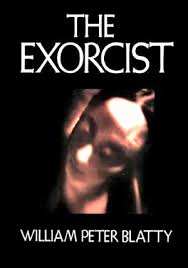
BOOK REVIEW: The Exorcist, by William Peter Blatty

The Exorcist

The Exorcist starts in Iraq, where an old priest on an archeological dig discovers a small amulet of the Assyrian demon, Pazuzu. He returns to America in a hurry, convinced he’s about to meet an old adversary very soon.  It then switches to Georgetown University where Hollywood actress, Chris MacNeil, is shooting a movie. She and her eleven year old daughter, Regan, are living in a rented house near the school while the film is in production. Regan is a sweet kid who also plays with a Ouija board and has a mysterious playmate she calls “Captain Howdy”. Soon strange poltergeist-like things start happening to Regan, and the situation gets very bad, very quickly. When the best doctors around can’t pin down the cause of Regan’s problems, they recommend she get in touch with an exorcist. Her mother, an atheist, gets in touch with the resident psychiatrist priest at Georgetown, Damien Karras, because there is literally nothing else to do.

Karras, a poor boy from Brooklyn whom the Church took in and educated, recently lost his mother. He is suffering heavy-duty guilt and has lost his faith. He reluctantly agrees to see Regan as a psychiatrist, but her mother keeps pushing for an exorcism.  Chris knows there’s something horribly wrong with her child, which she’s been told is not medical, while Karras is blinded by his scientific skepticism and lack of faith in God, or Devil.

I loved this book when it came out, along with the movie which came out two years later. (Yes, people really did faint and vomit during the movie. And run out of the theater.) Even though there is a lot of dissension when it comes to comparing movies to the books that they are based on, and vice versa, The Exorcist wins either way. Because the book’s author was also the screenplay writer, it is nearly impossible to discuss the book without also discussing the movie — The characters in the book are brought to perfect life in the movie, which made everyone — writer, readers, audience and producers — very happy.

Just like all the other “true account” stories we’ve read this semester, The Exorcist is based on a true story, but unlike all those other books this one really stands the test of time.  A big reason is that Blatty created some great characters in The Exorcist – Damien Karras is my favorite tortured priest. His adorable colleague, Father Joe Dyer, is adorable. Detective Kinderman is my favorite Columbo-impersonator, and Burke Dennings, the movie director, is an artistic genius in the field of profanity. Chris MacNeil and Regan are also well-drawn characters, just scaled down to more normal “human” proportions than the others. The Exorcist is also much more than a hair-raising story of demonic possession, and Hollywood shenanigans.  It is a deeply felt story of faith and redemption, and one of the few books to address the question of evil in the world in a sincere and thoughtful manner. Pretty heavy tunes for a “horror story”.

Incidentally, The Exorcist is loosely based on an actual exorcism performed on a boy in 1949 in St. Louis, Missouri by a Jesuit priest. Blatty heard the story while he was a student at Georgetown University in Washington, D.C. Honestly, this book practically wrote itself.

We should all be so lucky.

Blatty, William Peter. The Exorcist. 1971. New York: Harper Paperbacks, 1994. Print.

MOVIE REVIEW: Paranormal Activity, directed by Oren Peli

Paranormal_Activity_poster

Paranormal Activity is one of those “found footage” horror films that surfaces every few years to scare the latest crop of high school and college students. These horror fans generally love them because there’s always that slight possibility that they might be real. Movie studios love them unconditionally because they are always so damned profitable.

Paranormal Activity is the story of a woman, Katie, living with her boyfriend, Micah, in his house in San Diego, California. Micah is a day trader, and Katie is a student. Katie has already revealed to Micah that she’s been bothered by some kind of ghost ever since she was a kid before the movie starts. Also, early in the movie, Katie brings in a psychic who tells them she is haunted by a demon that feeds off negative energy, and that she should not communicate with it. Naturally, Micah has the idea to put a video camera in their bedroom so it can record what, if anything, happens while they’re asleep. Oh, and he also sets about looking for ways to communicate with it.

That this couple is in trouble is apparent early on.

Despite Katie’s insistence that she hates Ouija boards and doesn’t want Micah to bring one into the house, Micah does just that.  And what do we see one night when they both leave the house with the camera running in the living room? The planchette moves around the board spelling out some mysterious message and then the board bursts into flames. Take that, asshole boyfriend who never listens and refuses to acknowledge my feelings!

To be fair, though, the camera captures a lot of odd, but minor, events for the next several nights – noises, lights, doors closing, creaks, more flickering lights and eventually, a demon screeching.  During the day, Micah often picks up the camera and follows Katie around while he’s talking to her about her ghost experiences, including into the bathroom. One night Micah decides to sprinkle baby powder all over the floor in their bedroom, and the camera records strange footprints being made in the powder. The weird footprints lead to the attic and up in the attic is a burned photo of Katie when she was a girl.  When Katie becomes upset and wants to talk to a demonologist, Micah hates the idea, which is odd, given that he’s been so into “investigating” this whole haunting thing up until that point. However, when the demonologist is unavailable (how busy can those guys be?) she begs the original psychic to come back. Again, against Micah’s wishes.  When the psychic does show up again, he is such a useless weenie – refusing to do anything to help them because it would only make the demon angrier – that he’s an embarrassment to psychics everywhere.

Despite the obvious low-budget clunking (bad dialogue, bad acting, and implausible plot points) this film did have its moments – I thought the scene where something pulled the covers off one of them was good and creepy. Ditto for the scene where Katie gets out of bed in the middle of the night and just stands there, looking at her sleeping boyfriend – for two hours!

In general, this film was a disappointment, but not because it didn’t have a lot of cool special effects, or that it was slow in places. It failed, for me, mainly because Katie and Micah – the people we should be rooting for — quickly reveal themselves to be dim-witted and unlikeable. Since there was no real script (the actors were given a general outline of the scene before shooting and told to improvise), we are left to blame the actors in this situation and not, for once, the writers.

BOOK REVIEW: Grave’s End: A True Ghost Story, by Elaine Mercado, R.N.

Grave’s End is another “true account” ghost story. Only unlike The Amityville Horror, this story was not handed over to a professional writer for “touching up”. It is written in a straight-forward, journalistic style – this is what happened, this is who it happened to, this is how we all felt about it, and this is how it stands right now. Dull stuff compared to the sensationalized, and sensationalistic, Amityville Horror we just read! However, it can be claimed, too, that unlike The Amityville Horror, this ghost story might actually have happened.

When we compare the two incidents we see many differences:

  • Intense cold, devil pigs, green goo and ghostly marching bands in Amityville Horror
  • Feelings of paralysis, suffocating dreams, fleeting shadows and ghostly orbs in Grave’s End
  • Amityville Horror was a vacant, murder house on the market at a bargain price
  • Grave’s End was partially occupied and remained so for over 18 months after Elaine and her husband bought it
  • George and Kathy Lutz abandoned their haunted house in less than a month’s time
  • Elaine and her family are still living in their haunted house as of the book’s publication (2001)
  • The Amityville Horror was a hugely successful book and was adapted into several movies over the years
  • Grave’s End went unnoticed by nearly everyone, even people with a strong interest in the subject (like me!)
  • George and Kathy turned to a priest for help when things got really scary, but never felt like they could confide in any close family
  • Elaine had a strong ally in her brother, Ron, and turned to a famous parapsychologist, Dr. Hans Holzer for help
  • The whole Lutz family was terrorized by what went on and they all wanted to escape
  • Elaine and her daughters all felt the effects of their haunting, but Elaine was the only one terrified by it – the girls just thought it was interesting, and they were upset when the house was finally “cleansed” and most of the hauntings stopped

The extremely low-key handling of the events that happened in Grave’s End may have been due to a fear of a media backlash, such as occurred after The Amityville Horror was published. It may also have been the result of having an R.N. for an author, and not a Hollywood writer. And it may be so non-sensationalized because it was all true, and that’s how real hauntings look.

It certainly feels that way, in large part because there were no invisible pigs with red eyes, or cold, winter rooms full of flies. If my own ordinary experiences (and those of countless TV ghost-hunting shows) are any indication, that’s about the most anyone can expect from a real-live haunting – a few orbs, some funky shadows seen out of the corner of one’s eyes, and some weird, unpleasant nightmares.

One thing that Grave’s End showed me is that truth is just as strange as fiction – despite all the crazy crap that went on, and despite how thoroughly miserable Elaine felt for years – people have to be just about thrown out of a house they own, no matter how haunted it is, because they just refuse to leave!

Mercado, Elaine, R.N. Grave’s End: A True Ghost Story. 2001. Minnesota: Llewellyn Publications, 2006, Print.

BOOK REVIEW: The Amityville Horror, by Jay Anson

The Amityville Horror is one of the seminal “true story” horror stories out there. The other is The Exorcist, by William Peter Blatty, which we’ll be reading in a few weeks.

The story is, basically, that a family (George and Kathy Lutz and their three children) gets an incredible real estate “steal” in an affluent village on Long Island near New York City. The reason for the low, low price? It was the site of a horrible multiple murder just a year prior. Ronald DeFeo shot and killed six members of his family in their beds, in the middle of the night because he said, “I heard voices” (Anson 9). The unfortunate DeFeo family were all shot, execution-style, face down on their beds, in the back, at 3:15 a.m. No one in the neighborhood heard a thing. DeFeo was convicted of murder and sentenced to six consecutive life sentences.

A little over a year later, the Lutzes moved in just before Christmas. They endured an unbelievable series of strange events for 28 days, and then just abandoned the house and all their belongings.  They claimed they were attacked and tormented by demonic forces, and finally forced to leave, fearing for their lives.

I have to admit, I’ve read this book maybe a dozen times since it first came out. It scared the hell out of me the first few times, and the next few times I’d get a bit of a chill. Then finally I just gave my original copy away, because I’d decided that I had outgrown it. When I started this horror RIG I had to buy a new copy, and I noticed the publishers had updated it a bit for a more modern audience. This actually helped me get into the book again as a new-ish reader, and I have to admit that by the second or third night I was freaked out enough to wish I hadn’t left the book on my nightstand. So close to my head. In the dark.

Despite others’ complaints, I thought The Amityville Horror was pretty well written. The author, Jay Anson, was mostly a documentary film writer. Why someone thought he, of all people, should be the one to write this “true account” of a haunted house is a mystery. Nevertheless, I think he did a bang-up job. This book scared everybody when it came out, and if my experience is anything to go by, it’s still scaring people.

Some of the things I liked about this book:

  • My favorite scare is Jodie the Pig. That thing just freaks me out, and I like pigs. And the name Jodie.
  • George’s constantly waking up at 3:15 in the morning was a little scary too. Any time someone just wakes up at the same time every night makes me uneasy for some reason.
  • The strange siren call of the boathouse. Why was George so fixated on the boathouse? It’s never explained, and as far as I know nothing bad ever happened in there. So, weird.

Some of the things I didn’t like about this book:

  • George and Kathy Lutz. George was never a very sympathetic character, I felt. Anson tried to make out that George wanted this big house for Kathy “…George vowed to himself that if there was a way, this was the place he wanted his wife to have” (Anson 13). But all I saw was a self-centered guy with lots of big, expensive toys that needed housing (like his motorcycles, “a twenty-five foot cabin cruiser and a fifteen foot speed boat”), and low impulse control (Anson 16). Kathy was another classic Seventies Dishrag. When her son, Danny, has his hands weirdly crushed flat by a window frame, Anson writes, “There was as much of a storm raging inside 112 Ocean Avenue as outside, as Kathy chased after her husband asking him to call a doctor for Danny” (Anson 247). Really? Bitch doesn’t know how to use a phone?
  • I didn’t like how the Lutzes (mostly George) always kept Harry the dog outside in all kinds of horrible weather. To be fair, they did let him inside. Occasionally. The bastards.
  • Finally, I didn’t like how the authors of books like this always go out of their way to tell you how freaking religious the victims are. They always just happen to know a priest who’s not doing anything right now, so why don’t you come on over to our house and bless it?

Despite these complaints, I think everyone has to read The Amityville Horror at least once in their lives in order to consider themselves well-read, informed adults.

Anson, Jay, The Amityville Horror. 1977. New York: Pocket Star Books, published by Pocket Books, a division of Simon & Shuster, Inc., 2005. Print.

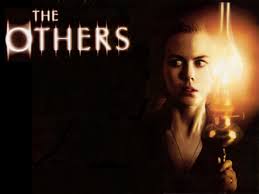
MOVIE REVIEW: THE OTHERS

TheOthersThe Others, is a 2001 film written and directed by Spanish filmmaker Alejandro Amenabar.  It stars Nicole Kidman as Grace Stewart, a woman living in a dreary and isolated mansion with her two children just after World War II. The children, Anne and Nicholas, have a rare genetic disorder that makes them dangerously sensitive to the light, so the house is always dark.  The family exists, more or less happily, in the house which is governed by a set of religiously strict rules, designed to protect the children. However when new servants arrive to replace the ones who have mysteriously disappeared, strange things begin to happen. Eventually, despite her staunch Catholicism, Grace becomes convinced that her house is haunted.

The filmmaker wanted to create a ghost story driven by atmosphere and mood, and not by gore, special effects and jump scares. He was also, reportedly, a big fan of M. Night Shyamalan’s The Sixth Sense and wanted a twist ending. He accomplished all these goals, but in the process, I think, he proved that just by making a different ghost story, he didn’t necessarily make a better one.

By American standards, this film was slow. I say “American standards” because I think it did very well in the rest of the world. It did okay in the U.S., but that may have been mostly the result of the relatively new “twist ending” (The Sixth Sense had been released only two years earlier).

As far as my personal standards go, I found The Others to be slow too. It had great atmosphere, and the dark, depressing mood was effectively maintained throughout. I thought the setting (an isolated mansion somewhere in the U. K.), and the time period (the immediate aftermath of World War II) both combined to reinforce the gloomy feeling. Nicole Kidman was great, as always, and we even got to see a former Dr. Who, Christopher Eccleston, for a few moments.

I saw it when it first came out, and I have to admit, I missed a lot of the clues to the twist ending the first time (although I did get a feeling of something being not quite right after a while). Seeing it a second time it was easier to spot the clues. This was mostly because the film was so slow there was never any sense of being swept away by the action, or the story. And that’s the main problem with slow, atmospheric movies with twist endings – once you’ve seen it, it’s not really possible, or desirable, to see it again. Its whole essence is tied up in the surprise at the end, unfortunately.

Despite that, The Others pretty much single-handedly turned all our usual “haunted house” expectations on their heads. It was fresh and a little chilling to see a haunting from the ghosts’ perspective, even if the ghosts didn’t know they were ghosts until the very end. It also made us aware that behind every “exciting” ghost story there is a tragedy lurking in the background. In this case, Grace, driven mad by despair at the loss of her husband in the war, smothered her two children and then shot herself to death.

The Friendly Editor

Advice from an Editor's Desk

Weirda Curiosities

Paranormal Tarot Magick

Kent Wayne

Epic fantasy & military sci-fi author.

Really Awful Movies

Horror, action and exploitation movies that aren't really awful at all.

One More Story

Tell your ghost story. Read some of mine.

Ryu Cope

WRITER/FILMMAKER/URBAN MISFIT

Kristen Lamb

Author, Blogger, Social Media Jedi