“Alien,” directed by Ridley Scott

Basically a monster movie set in space, this movie broke so many of the horror genre rules that audiences are still reeling.

The story is set far in the future. A commercial mining ship, called the Nostromo, is heading back to Earth after an unknown period of time. Its seven-member crew is in stasis until the ship receives a mysterious transmission, a possible distress signal, originating from a nearby planetoid. The ship’s computer, Mother, wakes up the crew. Per company policy they are required to investigate, so they land on the howlingly hostile surface, damaging their ship in the process. A few of the crew members – Dallas, Kane, and Lambert — head out to track down the source of the signal. They find a derelict alien ship that has crash landed nearby. Inside are the enormous remains of an alien pilot, its chest burst open from within.

Back on the Nostromo, Ripley has just figured out that the signal is a warning, not a plea for help. And around the same time, Kane discovers a huge chamber full of strange, alien eggs on the derelict ship. Dropping down into the mist-covered space to get a closer look, Kane is attacked by a creature that springs out of one of the eggs, dissolves the faceplate of his helmet, and attaches itself to his face, all in the space of about two seconds. Upon their return to the Nostromo, Kane and his rescuers are allowed back inside when another crew member, Ash, defies the quarantine rules.

From this point on, the crew of the Nostromo are pretty much screwed.

Oh, but what a lovely way to go.

First of all, the monster, a.k.a. the “alien”, is unlike any other monster we’ve ever seen – it is sleek, gorgeously alien, and sexy. This monster is no lumpy mess of mismatched parts; no giant furball bound to the phases of the moon as if caught in the world’s worst period; no social outcast with a weird lust for human body fluids — this creature is an artistic pairing of form with function. If it were a car it would be the 1956 Jaguar XK140.

Combine this body with a kind of “molecular acid” for blood, and the Alien is nearly unstoppable. They don’t dare shoot it, or blow it up, because its acidic blood can, and will, go right through the hull of their ship. So what can they do to get rid of it? They decide to trap it and jettison it out into space.

And this is where things in horror-genre land start to get a little wobbly, because the heroic captain, Dallas, climbs into the ventilation system in an attempt to herd the alien into an airlock so they can blow it the hell into space … and he gets ambushed by the alien. And dies. Even worse, his next-in-command is Ripley, a woman. Who goes on to be the only survivor. What??

Believe me, in 1979, when this hit the theaters, you could literally hear the needle scratch across the cosmic record of reality. I mean, it was LOUD. For the first time ever, women in horror were not the stupid, annoying, half-naked victims, but the heroes.

The screenwriter of “Alien”, Dan O’Bannon said this about the movie:

“One thing that people are all disturbed about is sex… I said ‘That’s how I’m going to attack the audience; I’m going to attack them sexually. And I’m not going to go after the women in the audience, I’m going to attack the men. I am going to put in every image I can think of to make the men in the audience cross their legs. Homosexual oral rape, birth. The thing lays its eggs down your throat, the whole number.'”(1)

 Pair this level of evil intent, along with the best tagline ever — “In space no one can hear you scream”  — and you see why “Alien” is the best monster movie, ever.

  1. Dietle, David (January 2, 2011).“Alien: A Film Franchise Based Entirely on Rape”.CrackedArchived from the original on March 2, 2011. Retrieved October 10, 2016.

World War Z: An Oral History of the Zombie War, by Max Brooks

world_war_z_book_cover

This is the story of the world’s first, and hopefully, only zombie holocaust. It’s a collection of private stories told by survivors about ten years after the initial viral outbreak that eventually brought the world to its knees. These stories are presented in an effort to “humanize” the events that were officially chronicled, and presented to the UN, by the researcher who collected them.

Brooks’ tale follows the unbelievable chain of events in roughly chronological order, from the beginning to the aftermath. Every personal story is like a brightly-colored skein of yarn, which the author ultimately fashions into a fascinating story-garment. From the Chinese doctor who stumbles across Patient Zero while on a house call in the middle of the night in a town that had no official existence; to the soldier who barely survived The Battle of Yonkers (in a classic example of a military clusterfuck); to the blind hibakusha who was saved from a zombie by a bear – we meet an international cross-section of survivors – good people, bad people, people “in the know” who should have known better, and people who did “know better” but who couldn’t seem to stay out of their own way (thinking here of that group of celebrities on Long Island who televised their nice, cozy sanctuary to the whole world, much to their eventual regret).

I loved so much about this story — the different voices, the realistic detail, and the clear-eyed gaze with which Brooks looks at his fellow human beings. I can honestly imagine every single horrible event he described actually happening – the guy who created and sold the false zombie vaccine, Phalanx? Definitely. The horribly jaded former White House Chief of Staff who belittled and minimized the early Israeli report on the outbreak, and then denied and covered up the mess when it hit America? Ditto. The illegal organ transplant doctor who helped the outbreak take root in South America by giving a wealthy patient a zombie-contaminated heart from China? Bitch, please.

However, for every realistically awful thing Brooks describes, he matches it with some realistically nice moments — like the Indian fisherman who rescued a struggling swimmer, and then refused to take any money from him; and the downed pilot who got “saved” by a voice on the radio that refused to let her quit. There were many others, too.

My point is, that Brooks’s story is an amazing, multi-layered, cleverly constructed bunch of bits that somehow manages to be one of those wholes which is greater than the sum of its parts. However, for the reader who wants to skim through the book in typical grad student fashion — gleaning the “important parts,” and getting the “gist of it” – this book will thwart you at every turn. It can be, and is, absolutely maddening that way.

I also loved the movie based on the book. And while very different in structure – the movie actually had a traditional story-line structure – it still managed to remain true to the book, while adding little bits of its own (scary-fast zombies, I’m looking at you).

It’s funny, but I read an interview with Max Brooks concerning this book, and its predecessor, The Zombie Survival Guide: Complete Protection from the Living Dead. Mr. Brooks, son of immortal funny man, Mel Brooks, actually fears that the zombie apocalypse could really, really happen, and that he wrote these books as way of coping with that fear.

So whether you love it, or hate it (or think it might actually happen someday), it’s hard to deny that there are some real pearls in here.


Brooks, Max. World War Z: An Oral History of the Zombie War. New York: Three Rivers Press, 2006. Print.


“Night of the Living Dead,” directed by George Romero

I chose the original 1968 version of this movie for two reasons – the original is almost always the best version, and it was free on “On Demand.”

A lot has been written about this movie since its release. It’s been called the “first-ever subversive horror movie”; critiquing   American society, the military, racism and our involvement in Vietnam (Wikipedia). And although it never used the word “zombie,” it launched the entire zombie media franchise that followed, continuing even up to the present.  Adults were appalled by the gore and utter nihilism of the film. Teenagers loved it for those very same reasons.

There were a number of things I liked about “Night of the Living Dead”. The monsters were mysterious in makeup and origin – what the hell were they, really? And where did they come from? The radio newscaster kept babbling, “They look like ordinary people. They look like us.” Which is apparently scarier than monsters that just look like, well, monsters. There was some vague attempt at explaining the reason behind what was happening – something about a radioactive space probe returning from Venus that was deliberately exploded in the Earth’s atmosphere once the radiation was detected. So, stray Venusian radiation gently wafting down to Earth causes zombie-ism. Who knew?

I also liked how the hero of this movie just happened to be a black man. Duane Jones, a former university professor, played Ben as a calm, resourceful and intelligent survivor.  The actor refused to play the role as it was originally written – Ben was supposed to be a simple, uneducated truck driver — so he re-wrote it. Talk about subversive!

I liked the zombies, which were called ghouls in the movie. They were not the full-fledged, foot-dragging, “Braiiiinnns”-moaning zombies we’ve all come to know and love, but the seeds are there. To me, Romero’s zombies looked more like stunned survivors of a nasty hit on the head than re-animated corpses, but they were chillingly relentless. Once they knew what you were (alive and tasty), and where you were (hiding in some silly, old car, or in an abandoned farmhouse), there was practically no stopping them. That was good and creepy.

However, I am sad to say all that monster-y goodness pales in comparison to the sexist depiction of Barbra. She was okay in the very beginning when she and her brother, Johnny, arrive at the cemetery for their annual visit to their father’s grave. Even when Johnny teases her with the iconic line, “They’re coming to get you, Barbra,” she is sympathetic. After all, anyone can have their one thing that makes them just wimp out. That’s fine. Totally understandable. But why, oh why, does Barbra appear to lose her mind once Ben shows up? I didn’t time it exactly, but I estimate that, once he appears at the farmhouse (chased by zombies) and starts to barricade them both inside, Barbra spends the next twenty or so minutes silently falling apart. She can’t talk and she can’t help with anything useful. From then on, she’s just scared. And useless. And ridiculous. I hated her. I wanted to grab her and shake her until that stupid blonde wig fell off her head. The other women were almost as bad. The mom in the basement, Helen, was a cypher. The sick- daughter-turned-zombie, Karen, actually does something – she eats her father’s corpse, which is all kinds of crazy-Freudian.

Yes, I know it was only the Sixties – way too soon for kick-ass female characters to be appearing in movies – but honestly, George, while you were being all “subversive,” and hiring a black, male lead to head your otherwise all-white cast, would it have killed you to maybe think outside the box just a little bit more, and not make Barbra such a fucking dishrag?

Sigh.

Sources:

Night of the Living Dead, from Wikipedia. https://en.wikipedia.org/wiki/Night_of_the_Living_Dead. Accessed 5 October 2016.

“The Yattering and Jack,” by Clive Barker

This story is in the first Book of Blood, right after another one of my favorites, “The Midnight Meat Train.” I feel like its placement there was a nice choice – a little something to give readers a break after the traveling abattoir story.

The Yattering is a very “lesser demon” assigned the thankless job of “catching” the soul of one Jack J. Polo, originally promised to Hell by his Satan-worshipping mother. However, when his mother cheated Satan by dying in the arms of a priest, the contract between mother and Hell-spawn was cancelled. Unwilling to let bygones be bygones, Beelzebub sent his minion to collect anyway.

On the one hand, I always felt like Barker was having a little fun with this story. He created the terminally dull Jack Polo, and then had him play his role to the hilt, eventually driving the Yattering mad with frustration. (And anyone who’s ever dealt with the terminally dull can empathize with the Yattering’s misery.) It’s fun to cheer at the end when the Yattering screws itself and chases Jack out of the house and actually lays hands on him – effectively making its former victim now its master.

But then, when you look closer it’s not really that funny. While Polo played deaf, dumb and blind, the demon killed every animal brought into the house and drove Polo’s youngest daughter, Amanda, mad. The oldest daughter, Gina, survived, and actually figured out what was going on near the end. If Barker had given Polo just the one daughter, Gina, who joined in the fight at the end, I would have called it a happy ending. Yay, humanity wins again. However, the younger daughter’s madness is problematic, and not something I could just ignore.

You could argue that Polo, perhaps, had no choice but to let things play out the way they did. He might not have realized how horrifying the Yattering could be – especially to the average person with no particular knowledge of demons, unlike himself.

I personally never thought that Polo willfully sacrificed his daughter’s sanity just to save his own ass. Yes, it was important for him to win, but not just in an ego-centric way. He was fighting for his very soul, and he may have believed it was important for him to win in a much larger sense. It’s not outrageous to think that there might have been a sort of “granddaughter clause” in Mom’s original contract – you can have my soul, my son’s soul and his daughters’ souls – all for one low, low price.

In my fantasy continuation of the story, Polo keeps Amanda at home with him; taking care of her while – in between selling gherkins – he turns the Yattering into his own private butler, cook, guard dog, and nursemaid for Amanda. I can even see the Yattering gradually becoming visible, because he has fallen so low on the demon hierarchy — forced to wear unfashionable clothing to hide its hideous nakedness, even down to wearing an apron with happy lobsters crawling all over it. Amanda eventually grows used to the hapless demon, growing stronger in mind and spirit. She comes to pity its trapped existence, and even ends up feeling sorry for it. Maybe Amanda’s pity is the solvent that ends up destroying its ties with Hell and setting the Yattering free.

I don’t know if Clive Barker set out to make this a story of one demon’s possible redemption, but I’d like to think that there’s hope for everyone, and everything. Even a demon as hopeless as the Yattering.

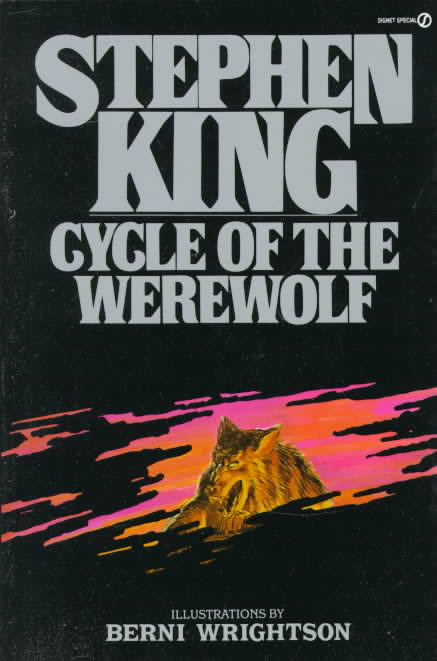
Cycle of the Werewolf, by Stephen King

cycle-of-the-werewolf-cover

I was amazed to discover that I had never read this particular King novel when I saw it on the syllabus. However, when it arrived in the mail (thanks, Amazon) I could see why. It was an early form of the graphic novel, only unlike most graphic novels this one is more story than comic book. Nevertheless, I might have passed it by in the old days, thinking it wasn’t anything special and even if it was I couldn’t afford to spend X amount of dollars on a Stephen King book that wasn’t at least eight hundred pages long. So, I never read it. Until now.

Cycle of the Werewolf is actually twelve short stories held together by a common theme in a single location, a little town called Tarker’s Mills.  There’s one story for each month, each full moon, of the year. Berni Wrightson’s illustrations are part of the engine that runs this beast. You could have the story without the pictures, or the pictures without the story, but why would you? They go great together. Kind of like chocolate and peanut butter. (Or maybe vodka and grapefruit juice?) The one informs and supports the other.

The stories start off, like so many of King’s stories it seems, with some old coot cheating at Solitaire. Then a dog scratches at his door during a January blizzard, and while the old coot is still thinking about the chances of that happening, the door smashes in and the monster gets him. The same story basically repeats itself for the next several months. The monster eats a lovelorn fat woman, a hapless drifter, a kid with a kite, a janitor, a café owner … until the Fourth of July when the monster finally meets his match – a ten-year-old boy in a wheelchair.

I loved a couple of things about this book. One was the format. Breaking a big story down into a bunch of smaller ones, but with a unifying theme has probably been done before. However, this idea, along with this particular execution of it, felt brilliant.  The other thing I loved about it was King’s use of the important “kid” events of the year to empower his hero.

Every American kid loves the Fourth of July, and Hallowe’en, and getting to stay up late on New Year’s Eve. (Christmas is strangely absent from this list, perhaps because any mention of Christmas in a story automatically makes it a “Christmas story.”) So, in this non-Christmas story, King’s hero first wounds the werewolf on the Fourth of July with a pack of fireworks. He discovers who the werewolf is on Hallowe’en while he’s out trick-or-treating, and he slays the beast on New Year’s Eve with his uncle’s gun and two silver bullets. It doesn’t get much better than that.

Except when it does.

Two of my favorite bits are a couple of little “extras” thrown into the story. One is that the kid in the wheelchair has an ally; his Uncle Al. Uncle Al is the uncle that every kid wants, and all too often, needs. He listens, he empathizes, and he doesn’t tell you to “Grow up” when you tell him something a little bit crazy. The Uncle Als of the world remember what it was like to be a kid in a grownup world.

The other bit I liked was how King took his secretly abusive husband character all the way through the story, unnoticed and unharmed, until the very end when he made old Milt Sturmfuller the werewolf’s last victim. Booyah.

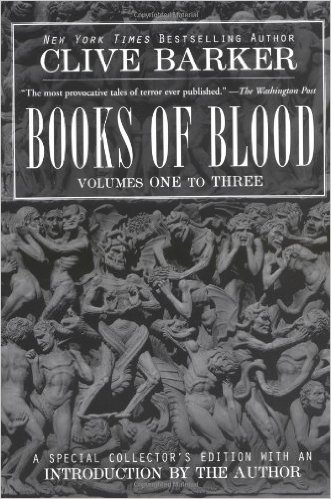
“Rawhead Rex,” by Clive Barker

books-of-blood

“Rawhead Rex” was one of the standout stories in Barker’s Books of Blood series. This piece appeared in the third volume, right after “Son of Celluloid” – one of my favorites. Some have complained that it is sexist, but I don’t feel that way. To me there is a BIG difference between talking coarsely about the female body: “her belly swelling with children, tits like mountains, cunt a valley that began at her navel and gaped to the world,” and having a bunch of horrible things happen to female characters just because they are women (I’m looking at you, Breeding Ground) (405).  So, yeah, Barker’s language and sensibilities are not for everyone, but his female characters are always people, and never singled out for special attention by the monsters simply because of their gender.

Rex is an ancient monster, buried under a huge rock in a field abandoned for generations by the town’s ancestors.  It is the unlikely and unfortunate combination of evils – Rex on the one hand, and greed for wealth on the other that sets the stage for all the horrors to come. Thomas Garrow, the man who unearths Rex while trying to ready his fields for some kind of cash crop to “bolster his shaky finances,” stubbornly attacks Rex’s headstone despite several signs – tractor problems, a thunderstorm, a horrible smell of death — thrown in his path (365). Even though the universe, it seemed, threw everything it could think of to get Garrow to do one, simple thing – STOP – nothing mattered.  Rex’s “birth” from the earth was inevitable, and like some horrible baby, he emerged. And then there was the usual blood and screaming that accompanies all births.

I love how Barker always has so much else going on in his stories besides the monster. In this one there is sex, violence, religion – both old and older, good and evil, faith and its lack, city versus country, the past versus the future, and probably a few more.  As others have mentioned, he also took a lot of care with the names in this story –

  • The town was named Zeal (so the inhabitants were, naturally, zealots)
  • The old priest was named Coot (as in, ‘you old coot!’)
  • The village pub, “The Tall Man,” was probably named for Rex who was very tall
  • The priest’s traitorous assistant, Declan, was named ironically as the name means “man of prayer”, or “man of goodness”. Also, St. Declan’s Stone was supposed to be the site of miracles in Ireland.
  • The hero, named Milton, who in the end defeats the devil, Rex
  • Even a minor character like Gissing, the cop, who assures Milton that the police will catch their mysterious killer – “Like that” – is not really a name, but a Dutch word, meaning conjecture, guess, guesswork (381).

Barker’s monsters have always been true monsters in that they wade through humanity, plucking the sweetest plums – children – for their favorite treats.  Which is, I suppose, how real monsters would act.  So, although everyone is fair game in a Clive Barker story, the tastiest morsels are always the young ones. At least that’s what the people who eat veal and lamb say. Stephen King, on the other hand, rarely lets his monsters kill children, and when he does, it’s to show us how stupefyingly horrible the monster is.

It’s for this one reason alone that I’d like to believe all the monsters who are out there love Stephen King more than they love Clive Barker.


Barker, Clive. Books of Blood: Volumes One to Three. Vol. 3. New York: Penguin Group, 1998. Print.

http://www.babycenter.com/baby-names-declan-463125.htm

http://www.wordhippo.com/what-is/the-meaning-of/dutch-word-gissing.html

Breeding Ground, by Sarah Pinborough

When I first started reading this book, I loved it. The descriptions were awesome, the pacing clipped right along, the first-person POV was fine, and the monsters were pretty good – for giant spiders. Giant, mutated spiders, in general, don’t scare me – although they probably should, given their power and ruthlessness. I also liked the setting – a cozy, little town in England in the modern era. It felt refreshing.

However, the first sentence of the first chapter has a woman, Chloe, complaining to her boyfriend, Matthew, that she’s gaining weight. Matthew reassures her with some early morning sex. Then Chloe discovers she is pregnant, which, mercifully, explains the mysterious weight gain. But then she gets too fat, too fast. A doctor is consulted who assures the unhappy couple that everything is proceeding normally, but when Matthew bumps into him in a pub later, doc tells a different story – something horrible and strange is happening in town, maybe all over the world. “Look at the women,” the doctor spits. (25)

And from that point on, the story starts to really go downhill.

It wasn’t just the misogynistic venom running through the story and in the survivor’s attitudes and words that bugged me. It was also all the glaring inconsistencies that resulted in so many mysteries that never get solved.

Like, where did all the dogs go? And what killed the cats?

Why were only deaf people and dogs immune to the monsters?

Why were only women the first targets of the spiders, and how did they all get pregnant? (I imagined alien spider spores wafting on the breeze until they detect estrogen on someone’s breath, and then – what? They hang around until you go to the bathroom and then creep inside and up to the uterus? Arrggh.) And did age matter at all, or would they impregnate anything with a uterus – old women, young women, girls, babies?

Why was Katie at first immune to the spiders — and in fact, she seemed to scare the nasty buggers — but then at the end, she gets spider bumps? And why “bumps” now, and not a regular “pregnancy” like the first wave of women?

Why did the smaller, black spiders – presumably male – need male hosts? And how did that work?

Why did human blood act like acid when sprayed on the spiders? And was it any kind of human blood, or only the blood of disabled people?

In addition, the protagonist, Matthew, while coming off sympathetic in the beginning – him being all loving and supportive of his grotesquely fat girlfriend – soon shows himself to be ready, willing and able to screw all the available women left on the planet. Thank God the little sister, Jane, got eaten by the spider before Matthew got to her. It was so bad that I actually wondered if he were somehow impregnating his girlfriends with the spiders.

I’m not sure if the author started out to write a book designed to reinforce primitive male fear and distrust of women, and the ever-changing female body, but that’s what she ended up with. Despite having some good spider monsters (which may have been surrogates for the mysterious and voracious human female, who knows, this shit is getting too deep for me), this book ended up disappointing the hell out of me.

Pinborough, Sarah, Breeding Ground.New York: Leisure, 2006. Print.

“The Funeral,” by Richard Matheson

Matheson must have based his funeral parlor director, Morton Silkline, on every stereotype he could find. Silkline is smooth, and he’s light on his feet; he really is like a dancer, gliding around, offering both sympathy and comfort to the recently bereaved. And all while never losing sight of the whole point of the thing for him – the money. That he does it all in a completely seamless, and genuine manner, is what makes him a perfect monster.

So it’s no surprise that word somehow gets out. To the other monsters, that is. (Because even monsters must have their own grapevine.) This is where Ludwig Asper comes in. Having been, most likely, unceremoniously dispatched by some blood-thirsty vampiric wretch hundreds of years ago, Asper missed the best part of dying – his funeral. So now he intends to make up for that by throwing himself a big bash at Clooney’s Cut-Rate Catafalque, and all his monster friends will be there. (Incidentally, I had to look up the word “catafalque” – it means “a raised structure on which the body of a deceased person lies or is carried in state; a hearse.”1)

I thought this story was a pleasant, little romp.  Silkline was perfect, and despite that little hiccup at the beginning, where he gets upset at Asper’s “joke”, by the end of the story he shows himself to be the ultimate parasite – totally adaptable to the new situation.  The best part of this story was all the other monsters who attended Asper’s “funeral.” As a few other people have already pointed out – this group acted like any other family. You had the cantankerous, but sweet, crazy cat-lady aunt; the creepy uncle (who never says anything but, “Tasty”); the dignified grand-dad, “Count”; the weird, werewolf cousin, and the assorted “others” who always seem to be there.

Predictably, this group of misfits is seldom in the same room together, and so are not very good at getting along. (Jeez, that sounds so familiar.) But, like most “normal” families, they make an attempt at being nice until the strain is too much for them, and then all hell breaks loose.

The story was a quick read, and it showed the author’s more playful side. I have to say, the creepy gnome-guy who kept murmuring, “tasty” was my favorite. I think I have sat next to that guy, or one of his relatives, on the subway a couple of times. Creepy! Jenny the witch was also good, mostly because I think I have become the “Jenny” in my family. (Eh. Someone’s got to do it.)

I also loved that Matheson did such a nice job of portraiture in this little story – I could see every character clearly, but none more so than Silkline.  It was fun to watch him morph from an ordinary, run-of-the-mill leech at the beginning of the story – plump, well-fed, doing very nicely, thank you very much – to an imperturbable and sleek bloodsucker.  As someone else so helpfully pointed out, Silkline had an actual character arc in this story.

His mother would’ve been so proud.


  1. dictionary.com

Matheson, Richard, “The Funeral”. I Am Legend. 1995. New York: Tor, 2007

I Am Legend, by Richard Matheson

I’ve always loved Richard Matheson’s work. He was writing genuinely good scary stuff back when everyone else equated “scary” with “juvenile, stupid monsters”.  This is the first time I had actually read this novella, though. I did see the movie starring Will Smith, which was excellent. But now, I’ve got Will Smith stuck in my head while I’m reading the story, and in many ways, I preferred the movie version.

Don’t get me wrong – I did appreciate that Matheson’s Robert Neville was a more nuanced guy than the average horror story protagonist, but every time Matheson mentioned the guy’s “blond hair” it threw me out of the story, because the whole time I was imagining Will Smith! Nevertheless, there was a lot here that I admired about Matheson’s take on this “the last man on Earth” story.

For one, I can totally see how, after several hair-raising months (years?) of dealing with these “things”, you would turn to drinking. A LOT of drinking, in his case.  I thought all that was both realistic and understandable. And, even though it is probably realistic, I really did not like how Neville kept obsessing over the female vampires. Has nobody told this guy about the wonders of masturbation?

Then again, this was written in the Fifties, so the answer is NO. And that’s why homeboy was half out of his mind with all those “forbidden desires.” Sheesh.

However, between the guy’s generally cranky demeanor, and all these other issues, I thought Neville was not a very sympathetic character. Interesting. Realistic. But not somebody I was rooting for.

Another thing, when I first see Robert Neville trying to figure out the nature of his vampire/zombies, I actually felt a little impatient.  Come on, man — Everybody knows what causes vampires/zombies, right?

But then I remembered. Everybody did NOT know about them back in the Fifties!

So, Matheson was kind of feeling his way around in the dark on that one. Interesting that he hit on the virus idea, though. And unlike some people, I liked the idea of the pathogen being spread across the country by dust storms. For one thing, it gave the setting more of an apocalyptic feel, plus it was a nice, fresh idea with visual appeal. I imagined these huge, brown dust storms blowing through a desolate and decayed Los Angeles. Cool.

I liked how Matheson chronicled Neville’s daily existence. It gave me lots of good ideas to use for when the zombie apocalypse really happens. I also liked how, once he sees, and then captures, the woman he then spends a lot of time stewing in paranoia and distrust. That felt realistic, too. After being alone for so long, he was bound to be suspicious of anything new that looked too good to be true.

The only thing that didn’t ring true in this story was the ending. Frankly, I did not get the reasoning behind why they felt they had to kill him. It made no sense to me. The guy was immune to the virus AND he managed to survive all this time on his own. Give the guy a medal, or at the very least, EXPERIMENT on him to find out his secrets! But, kill him? Bleh.

I also felt sorry for the way the so-called humans killed off Neville’s private pain-in-the-ass, Ben Cortman.

Anyway, I still love Matheson, and I think this story has a lot to offer us horror geeks. If for no other reason than to see the origins of so many future vampire/zombie story lines.

Matheson, Richard. I Am Legend. New York: Tor, 2007. Print.

MOVIE REVIEW: Ghostbusters, directed by Ivan Reitman

The semester is almost over, but we get to end it on a high note with the 1984 classic, Ghostbusters. Written by co-stars Dan Aykroyd and Harold Ramis it is the tale of three sleazy academic parapsychologists turned sleazy professional ghost hunters in New York City.

Peter Venkman (Bill Murray), Raymond Stantz (Dan Aykroyd) and Egon Spengler (Harold Ramis) get fired from their parapsychology research jobs at Columbia University after a ghost-hunting disaster at the New York Public Library. Since they have already developed their proton-pack weapons to fight the ghosts, along with a special containment unit to trap them, they decide to go into business for themselves as a paranormal investigations and extermination service. One thing they must never, ever do, says Egon is “cross the streams” coming from their proton packs. It would be cataclysmic.

They set up shop in a dilapidated old firehouse and go to their ever-more-frequent ghostbusting service calls in a restored hearse. They are soon hired by cellist Dana Barrett (Sigourney Weaver) who thinks her apartment is haunted by a demonic spirit called Zuul. Despite Venkman’s romantic interest in Dana, she still ends up possessed by Zuul, a.k.a The Gatekeeper. Dana’s nerdy accountant neighbor, Louis Tully (Rick Moranis), who is also interested in Dana, becomes possessed by Vinz Clortho, who goes by the moniker, The Keymaster. Needless to say, these two are destined to meet in a big way.

Since the Ghostbusters become extremely popular as a result of their ghostbusting activities, they end up on TV talk shows, on the covers of magazines, and on the EPA’s radar. They are housing an unlicensed hazardous waste containment facility in the basement of their firehouse, and the EPA brings the cops in to shut them down. The ghostbusters are hauled off to jail and all the previously contained ghosts escape and take over the city.

In the ensuing havoc, Vinz Clortho makes his way towards Zuul and the two do the nasty. They are consequently turned into hellhounds and open the gate to a supernatural realm allowing Gozer, Zuul’s boss, to arrive.

With the citizens of New York in a panic, the mayor has the ghostbusters released. They head over to Dana  Barrett’s apartment where Gozer tells the ghostbusters that “the destructor” will soon arrive, but in a form of their choosing. That’s when Venkman inadvertently thinks of the Stay Puft Marshmallow Man.

Finally, in order to destroy “the destructor” Egon tells them they must now “cross the streams.” They defeat the Stay Puft Marshmallow Man and Gozer and Vinz Clortho, releasing Dana and Louis from their gargoyle-like hound bodies. New York City is saved and the Ghostbusters are heroes. Yay!

This is one of the best ghost story movies ever. The characters are wonderful and the humor is great. It also stands up very well to the passage of time. If some of the special effects look a little creaky after all this time, it doesn’t matter as much because it’s a comedy. Bill Murray is a blast as the smarmy Venkman. Harold Ramis was terrific as the intensely nerdy Spengler and Rick Moranis was amazing as Louis Tully. Hard to believe the role was originally written for John Candy who declined because he just didn’t “get” the character. Sigourney Weaver is always good, even when she isn’t fighting aliens, and Annie Potts as the Ghostbusters’ secretary, Janine Melnitz, was a delight. All in all, a great movie to end on.

The Friendly Editor

Advice from an Editor's Desk

Weirda Curiosities

Paranormal Tarot Magick

Dirty Sci-Fi Buddha

Musings and books from a grunty overthinker

Really Awful Movies

Horror, action and exploitation movies that aren't really awful at all.

One More Story

Tell your ghost story. Read some of mine.

Ryu Cope

WRITER/FILMMAKER/URBAN MISFIT

Kristen Lamb

Author, Blogger, Social Media Jedi